How much faster are super shoes?
Carbon-plated shoes made elite men about two minutes faster over a marathon. Nobody records who wore what, so I compared runners with their own track times instead.
 Oliver FoxFounder of ontrack · doctor & researcher · runner
28 November 2026 · 3 min read
Short version: super shoes made elite men about 1.5% faster in the marathon, which is roughly two minutes on a 2:08. For women there isn't enough data to say either way.
To get there I scraped every result on the World Athletics season lists from 2001 to this November, from the 1500 m up to the marathon. That's 203,627 results from 18,130 athletes in 146 countries.
The problem: nobody records who wore what
The obvious test is to compare runners in super shoes with runners in normal ones. I tried to find the 2015 shoe sponsor for the 400 fastest marathoners and could only find it for 9 of them. So that was out.
Instead I used a quirk of the timeline. Carbon-plated road shoes spread through the elite field in 2016–17, but the equivalent track spikes didn't really arrive until 2020. And lots of elite runners race a marathon and a 5000 m or 10,000 m in the same year.
So for three years, the same person, at the same fitness, ran one race with the new technology and one without. If the shoes work, their marathon should get faster compared with their own track times. Comparing each runner with themselves takes fitness, age and talent out of the picture. Anything that helps both races equally, like better training or nutrition, cancels out too.
What the numbers say
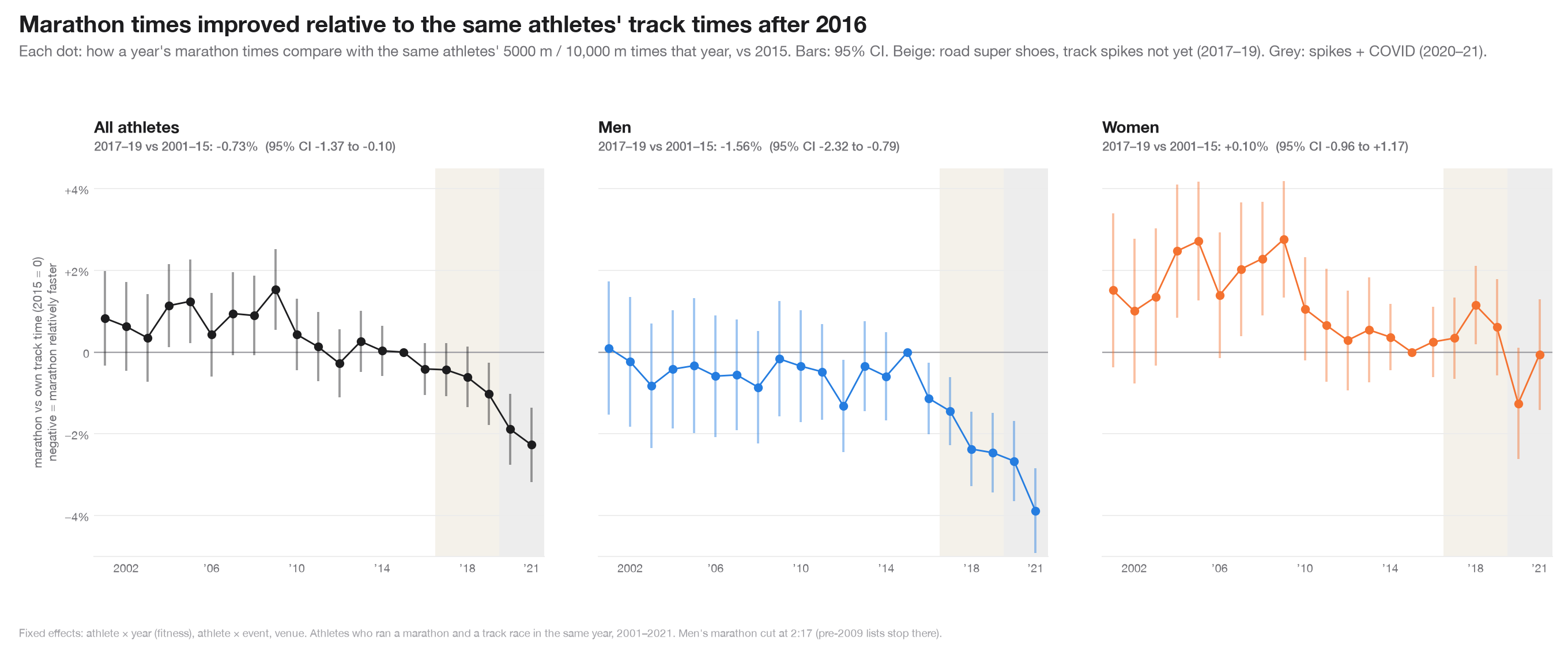
There were 1,359 athletes who raced both in the same year, about 110 to 210 of them in any one season. From 2017 to 2019 their marathons got faster relative to their own track times:
- Men: 1.56% faster, about two minutes on a 2:08.
- Everyone together: 0.73% faster.
- Women: no clear change. Far fewer women race both in one year, so there's much less data, and the model just can't tell either way.
As a sanity check I pretended the shoes arrived in 2009 instead and ran the same model. It found nothing, which is what you'd hope.
You might expect the line to bounce back once the track got its own spikes in 2020. It keeps falling instead. I wouldn't read much into that: COVID cancelled most marathons that year, the few that went ahead were elite-only races on fast courses, and other brands were bringing out their own plated shoes at the same time.
So how much faster?
About two minutes for an elite man over a marathon, which is a big jump for one piece of kit.
The usual caveats apply. The lists only include fast times. Pacing and race tactics on the road changed over the same years, and I can't fully separate those from the shoes. And runners who race a marathon and a fast track race in the same year aren't typical of everyone.
Comparing a runner with themselves before comparing them with anyone else is the same idea that runs through ONTRACK.
▸How it’s made — the technical bit
How it's made
Data: World Athletics season toplists, every result, 2001 to 25 November 2026, 1500 m to marathon, men and women. 2,206 pages, with 64 empty pages caught and fetched again. Men's marathon lists are cut at 2:17 in every year, because the pre-2009 lists stop there.
Model: fixed effects on log time, with athlete × year, athlete × event and venue effects, and errors clustered by athlete. 8,495 results from 1,359 athletes, including 3,290 marathons. Main comparison 2017–19 against 2001–15, with 2016 left out as the changeover year. Men −1.56% (95% CI −2.32 to −0.79), all −0.73% (−1.37 to −0.10), women +0.10% (−0.96 to +1.17), placebo −0.26% (−0.76 to +0.23).