Ultrarunning series · part 2 of 3
When do ultrarunners actually peak?
Across more than two and a half million ultra finishes, the age at which ultramarathoners are fastest is far later than the track would have you believe — right around 40 — and the decline past it stays shallow until about 60.
 Oliver FoxFounder of ontrack · doctor & researcher · runner
20 June 2026 · 4 min read
Sprinters are finished by thirty. Marathoners hold on a little longer — the world's best are usually somewhere in their early thirties. The further the race, the later the peak, and ultrarunning sits at the far end of that line. The question is how far: when does an ultrarunner actually stop getting faster, and how steep is the fall once they do?
We took every fixed-distance ultra in the archive — 50Ks, 100Ks and 100-milers — and asked it directly. The answer is later than the track would lead you to expect, and the slope on the downhill side is shallow enough that plenty of people are running their best races at an age when a marathoner would have retired.
Every number here is built on the DUV Ultra-Marathon Statistik, the volunteer-run archive of ultramarathon results, via the published Kaggle dataset of 7.5 million finishes. Our thanks to DUV for keeping the sport's history.
The trap: old fields look slow, but that isn't aging
The naive way to read this is to plot finishing time against age and call the bottom of the curve the peak. It doesn't work, for the same reason ranking races by their clock doesn't work: the people who show up at 55 are not the people who showed up at 25. Beginners cluster at certain ages, the fast get filtered in and out, and a distance run mostly by veterans will look slow for reasons that have nothing to do with anyone's birthday.
So we do two separate things, and they tell the same story two ways. First, the population curve: standardise every finish against its own distance-and-sex cohort (a strong run scores below zero, a weak one above), then average that by age. That shows where the sport as a whole is fastest. Second, the within-athlete arc: follow each runner across their own career and watch their performance rise and fall relative to their personal average. That removes the who-shows-up problem entirely — it is the same legs, aging.
The curve
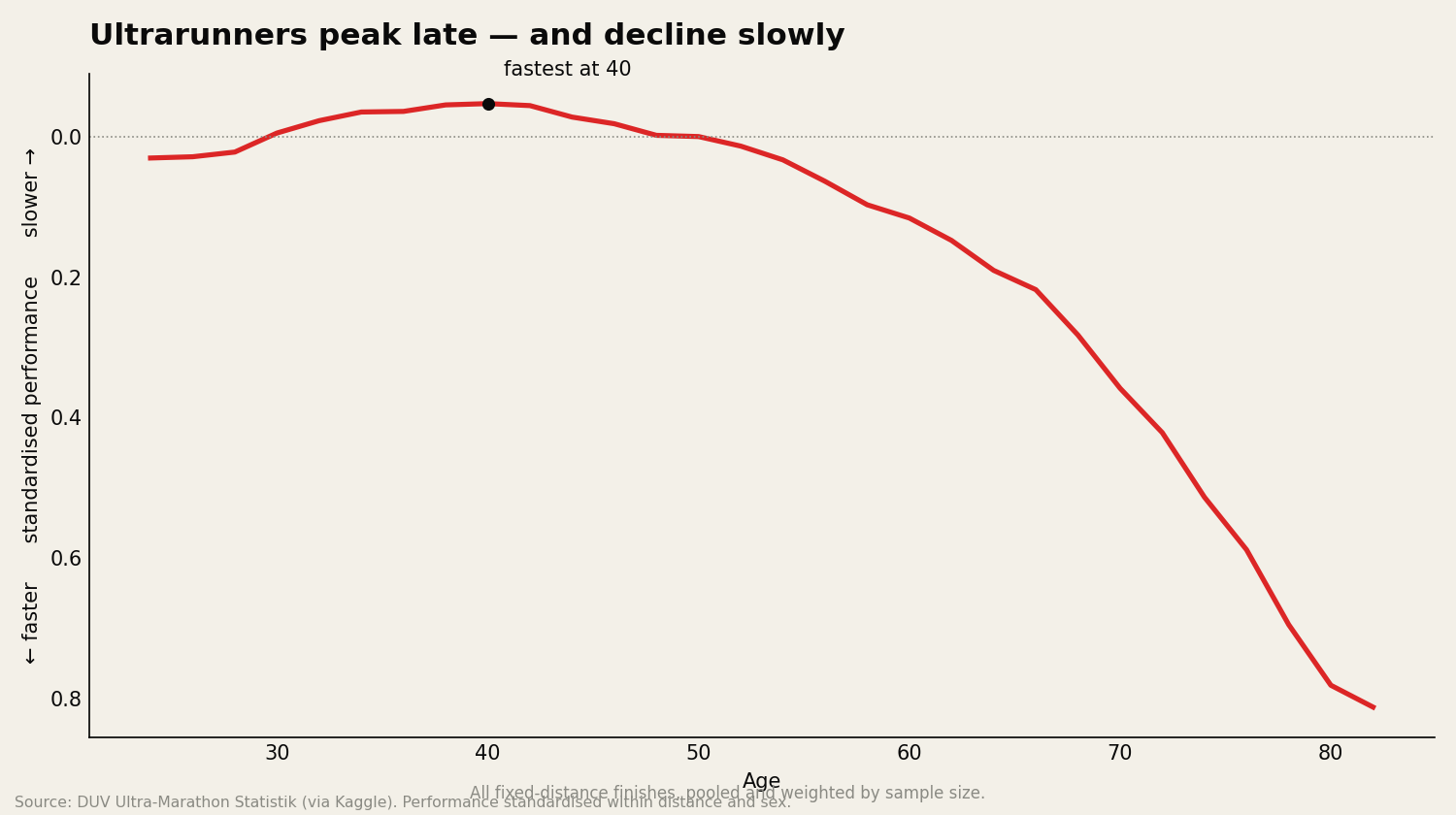
Pooled across every fixed-distance finish and weighted by how many ran, the bottom of the curve — fastest relative to the field — sits right around age 40, well past where road racing peaks. What is striking is not really the peak but the plateau either side of it: the line is close to flat from the early thirties into the mid-forties, so a runner at 44 is, on average, giving up very little to their thirty-year-old self. The decline only turns steep after about 60.
Splitting that single line back out by distance and sex shows how much the headline hides. The 50K and 100K curves track the pooled shape closely. The 100-miler is noisier and looks fastest younger — but that is the smallest, most self-selected group in the data (a fast 24-year-old who finishes a hundred-miler is a rare and unrepresentative animal), so read its early end with suspicion, not as a real peak.
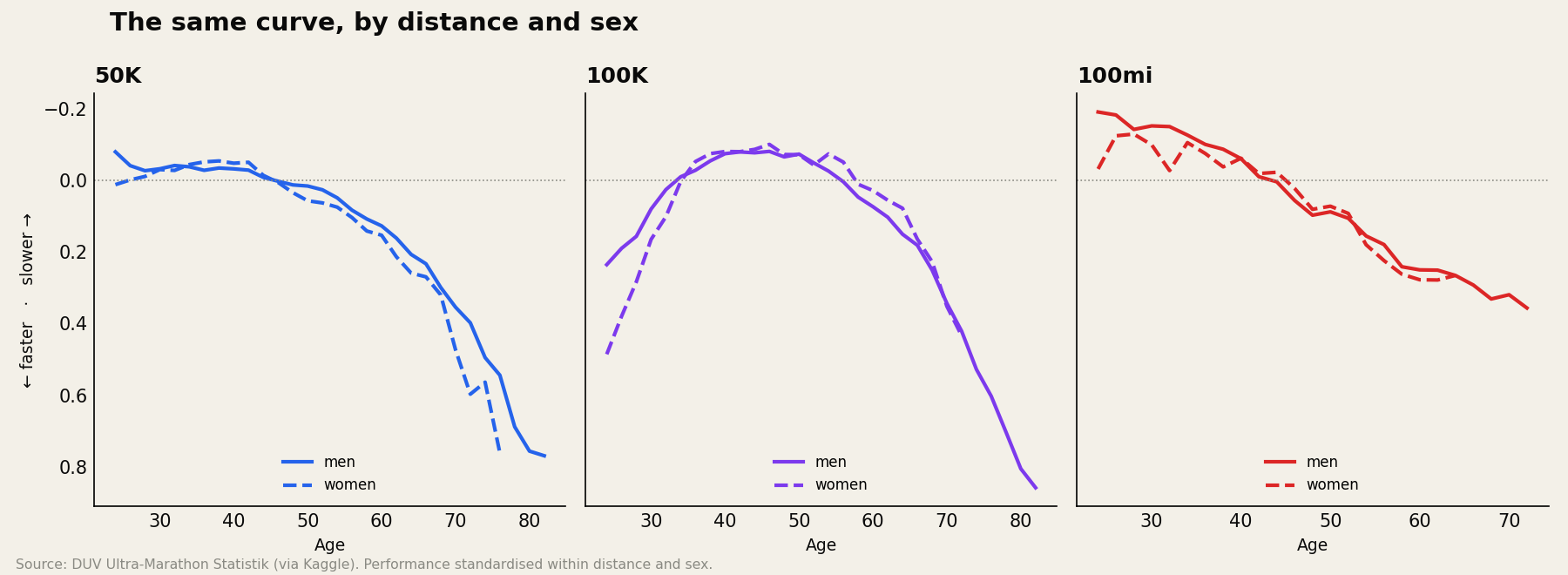
There's a real effect hiding in here and a selection effect sitting on top of it. The real effect is endurance: the qualities that win ultras — fatigue resistance, pacing judgement, the durability to train through years without breaking — mature slowly and fade slowly. The selection effect is survivorship: the people still lining up at 60 are the ones it never broke, so the old end of the population curve flatters itself. The within-athlete arc is how we separate them.
The same legs, year after year
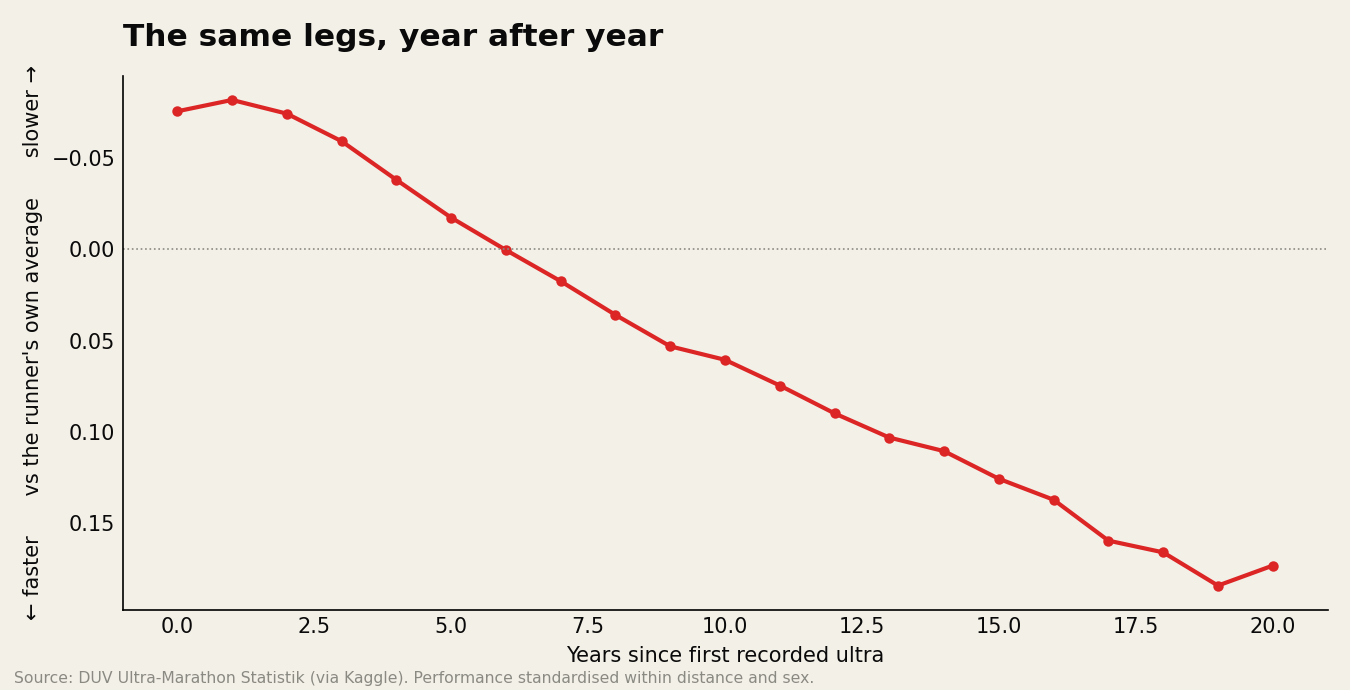
Followed across their own careers, runners keep improving on average for the first several years in the sport — learning to pace, to fuel, to not blow up at 60K — before the curve turns. That early climb is the part the population view hides, because newcomers and veterans are mixed together at every age. The downhill, when it comes, is gradual: a slow give-back, not a cliff.
Where the personal bests land
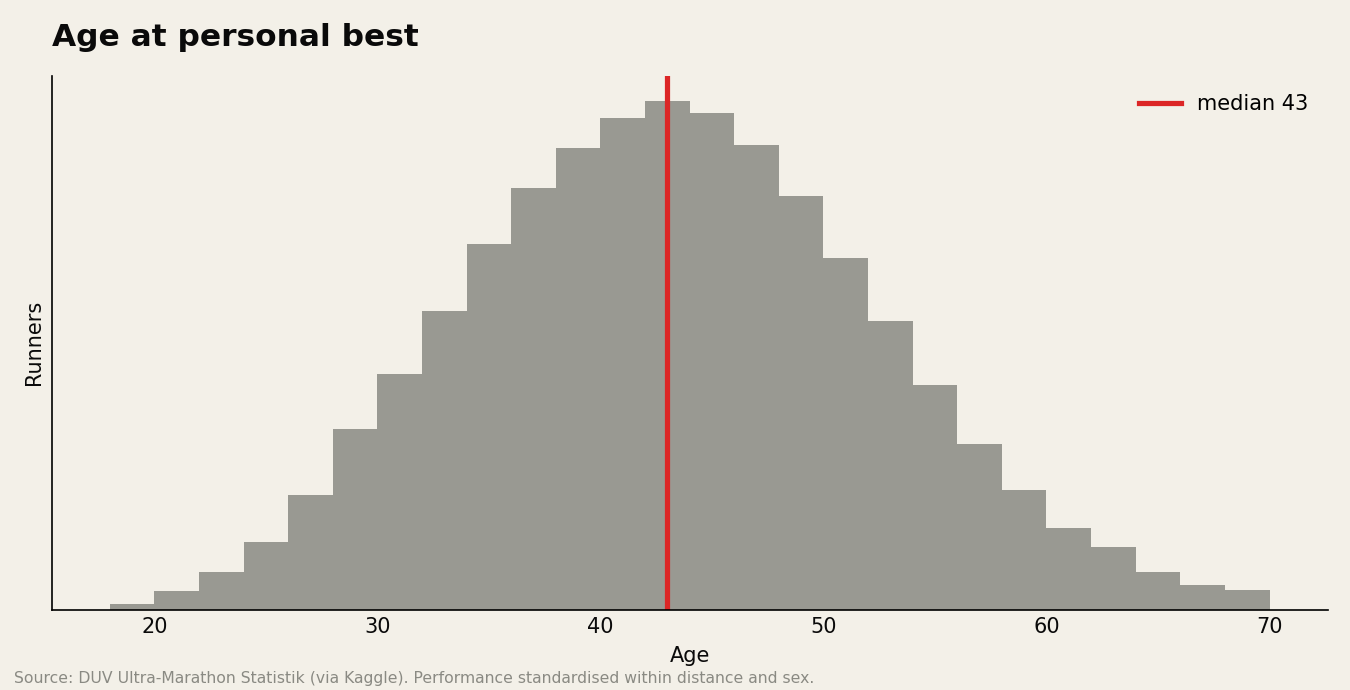
Pinning each runner's best race to the age they ran it puts a number on the folklore. The median personal best lands at 43, and the right tail is long — about one in five runners set their lifetime best after fifty. Some of that is genuine late blooming and some is simply that many ultrarunners arrive in the sport late and are still on their way up, but either way the practical message is the same: in this sport, your fastest race is rarely behind you as early as you fear.
One caveat: age here comes from year of birth, so it's good to the year, not the day; and we can only see the people who kept entering races. The ones who quit at 35 are invisible, which means the far-right end of every chart is the hardy survivors talking. The peak is trustworthy; treat the exact shape of the tail as the optimistic reading.
This is the second in a series built on the same 7.5M-result archive — the world's hardest ultras came first, and the closing gap between men and women at distance, plus an atlas of where the sport is exploding, are on the way. We build ontrack to turn the noise of real training and racing into something you can act on.
Ultrarunning series
Part 2 of 3
- 01The world's hardest ultras
- 02When do ultrarunners actually peak?you’re here
- 03An atlas of ultrarunning